National 5 Computing Science
Running total within a loop
National 5 Computing Science: Software design and development
A running total inside a loop is the other algorithm that comes up in the National 5 exam almost every year, often for 4 marks. The examiners' reports say many answers are left blank, or written without a loop at all.
The pattern
Five days of rainfall, in millimetres, are stored in an array. The program adds them up and works out the average:
DECLARE rainfall INITIALLY [12, 0, 7, 3, 18]
SET total TO 0
FOR index FROM 0 TO 4 DO
   SET total TO total + rainfall[index]
END FOR
SET average TO total / 5
SEND "Average rainfall: " & average & " mm" TO DISPLAY
Every running total has three parts:
- Before the loop: set the total to 0.
- Inside the loop: add the next value to the total. Here that is
rainfall[index], the next item in the array. - After the loop: use the total: display it, or work out an average.
The same program in Python:
rainfall = [12, 0, 7, 3, 18]
total = 0
for index in range(5):
    total = total + rainfall[index]
average = total / 5
print("Average rainfall:", average, "mm")
- A loop that runs the right number of times: 5 items means indexes 0 to 4.
- The value added to the total inside the loop.
- The next array item used each time, with the array name from the question.
- Any average worked out after the loop, not inside it.
Mistakes that lose the marks
- Setting the total to 0 inside the loop. It goes back to 0 every time, so at the end it holds only the last value.
- Adding the index instead of the item.
total + indexadds 0, 1, 2, 3, 4, not the rainfall. - Using your own names. If the question calls the array
rainfall, userainfall. A general formula with made-up names does not gain the mark. - Going one too far.
FOR index FROM 0 TO 5tries to read a sixth item that does not exist.
Try two exam-style questions
Choose an answer, say how sure you are, then press Check. Every wrong answer tells you why it is wrong.
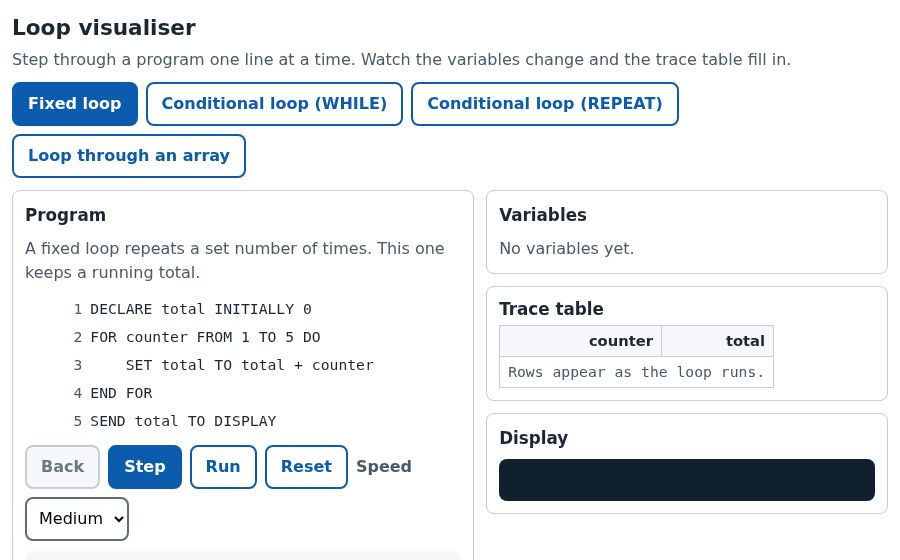
The full course covers every topic like this. Every topic in National 5 Computing Science has a short note, a simulation to try and a practice quiz with feedback on every answer, plus coding lessons, a full mock exam and a progress report for parents.
More guides
- Input validation: how to get all 4 marks
- round, random and length: writing the whole call
- Choosing the most suitable data type
- Evaluating a program: answers that gain the mark
- Concatenation: joining strings for the mark
- Iterative development: describing going back
- Testing: test data and test tables
- All the free revision guides
This site is independent: it is not connected to the SQA or Qualifications Scotland. Points from the examiners' course reports are given in our own words.