National 5 Computing Science
Concatenation: joining strings for the mark
National 5 Computing Science: Software design and development
Concatenation is one of the shortest topics in National 5 Computing Science, and one of the easiest marks to lose. The 2025 examiners' report found that many candidates could not describe concatenation, or even use the word, when a question asked for it.
What it means
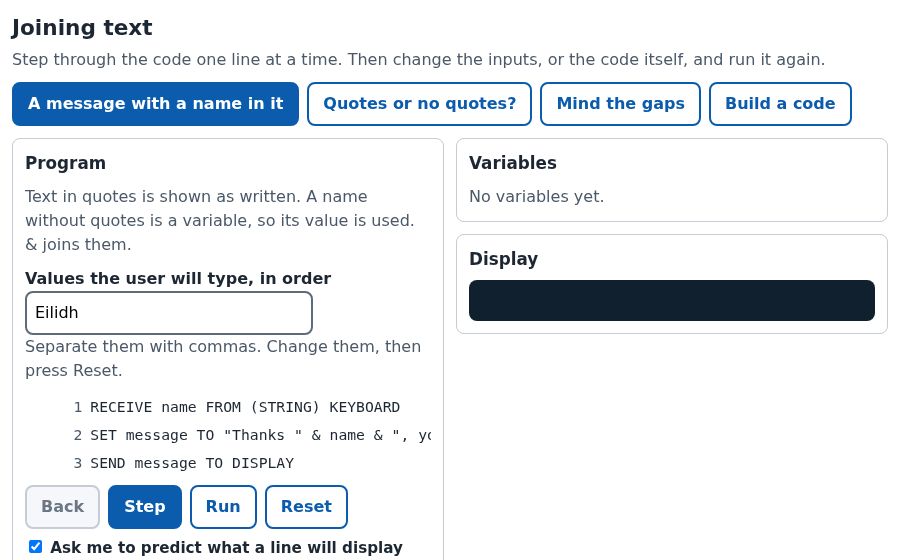
Concatenation means joining strings together to make one longer string. In SQA reference language the joining operator is &. In Python it is +.
SET firstName TO "Callum"
SET town TO "Stornoway"
SET message TO firstName & " lives in " & town
SEND message TO DISPLAY
This displays Callum lives in Stornoway. Notice the spaces: they are inside the middle string, " lives in ". The computer never adds a space for you.
The same program in Python:
first_name = "Callum"
town = "Stornoway"
message = first_name + " lives in " + town
print(message)
- "Concatenation": using the word, when the question asks you to name the technique.
- "Two strings are joined together to make one string": a description of what happens.
- "The strings are added together." Adding is arithmetic. Strings are joined, not added, so this does not gain the mark.
- "It puts the words together." Too vague: say that strings are joined into one string.
Joining a number
Reference language lets you join a number into a message directly:
SET seats TO 4
SEND "There are " & seats & " seats free" TO DISPLAY
This displays There are 4 seats free. In Python, a number has to be turned into a string first with str(), or Python stops with an error:
seats = 4
print("There are " + str(seats) + " seats free")
Mistakes that lose the mark
- Putting variable names in quotes.
"town"is the word town, not what the variable holds. - Forgetting the joining operator between two parts, or putting a dash outside the quotes:
town & - & seatdoes not work,town & "-" & seatdoes. - Missing spaces.
"Fort" & "William"displays FortWilliam. If the question shows a space, put it inside a string.
Concatenation often appears inside a bigger program, for example to build the final message after a running total. For which data types can be joined, see choosing the most suitable data type.
Try two exam-style questions
Choose an answer, say how sure you are, then press Check. Every wrong answer tells you why it is wrong.
The full course covers every topic like this. Every topic in National 5 Computing Science has a short note, a simulation to try and a practice quiz with feedback on every answer, plus coding lessons, a full mock exam and a progress report for parents.
More guides
- Input validation: how to get all 4 marks
- Running total within a loop
- round, random and length: writing the whole call
- Choosing the most suitable data type
- Evaluating a program: answers that gain the mark
- Iterative development: describing going back
- Testing: test data and test tables
- All the free revision guides
This site is independent: it is not connected to the SQA or Qualifications Scotland. Points from the examiners' course reports are given in our own words.