National 5 Computing Science
End-user and functional requirements
National 5 Computing Science: Database design and development, Web design and development
Both the database and the web sections start with analysis: what the solution must do. The examiners' reports for 2023 and 2025 say many candidates write an end-user requirement when a functional requirement is asked for.
The difference
- End-user requirements are the tasks the users want to do, in their own terms: "I want to see which campsite pitches are free in July."
- Functional requirements say what the solution must do to make that possible: the processes it carries out and the data it holds.
For a database
A campsite asks for a database. Campers said they want to find which pitches have electric hook-up, and see the price of each pitch.
- "Campers want to find the pitches with electric hook-up." (End-user requirement: it repeats what the users said.)
- "The database must store each pitch's number, price and whether it has electric hook-up." (Functional: data the database holds.)
- "The database must search for pitches that have electric hook-up." (Functional: a process it carries out.)
For a website
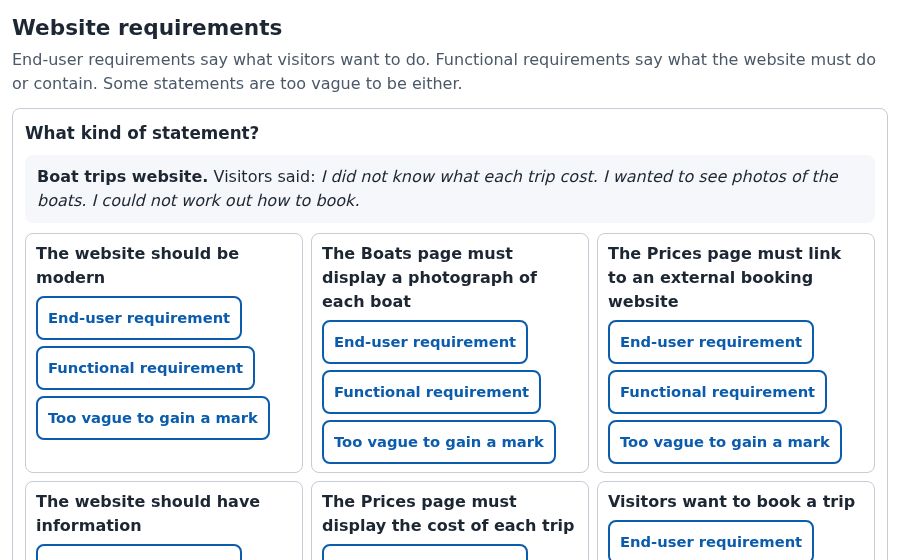
The same campsite wants a website. Visitors said they want to see photos of the site and find out how to get there.
- "Visitors want to see what the campsite looks like." (End-user requirement.)
- "The website must display photos of the campsite." (Functional: what the website must do.)
- "The website must have a page with directions and a map." (Functional.)
Start with what the solution must do: "the database must store / search / sort ..." or "the website must display / link to / play ...". Then name the actual data or content from the question.
Try two exam-style questions
Choose an answer, say how sure you are, then press Check. Every wrong answer tells you why it is wrong.
The full course covers every topic like this. Every topic in National 5 Computing Science has a short note, a simulation to try and a practice quiz with feedback on every answer, plus coding lessons, a full mock exam and a progress report for parents.
More guides
- SQL with two tables: the equi-join
- SQL UPDATE and INSERT without losing marks
- Referential integrity: explaining it for the mark
- CSS classes and external style sheets
- Absolute and relative addresses
- Making a sound file smaller
- Testing: test data and test tables
- All the free revision guides
This site is independent: it is not connected to the SQA or Qualifications Scotland. Points from the examiners' course reports are given in our own words.